Misallocation of Climate Innovation: Adaptation vs Mitigation
Abstract
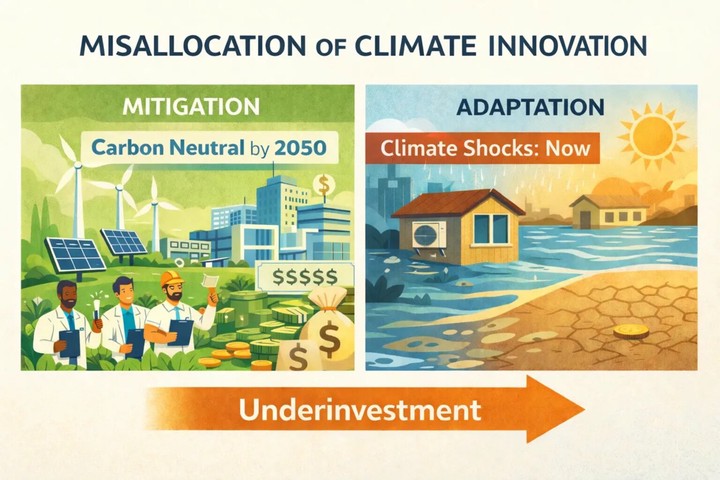
Climate innovation is overwhelmingly directed toward mitigation technologies, yet adaptation—reducing exposure to damages that are already locked in—may be at least as urgently needed. This paper asks whether the current allocation of inventive effort across mitigation and adaptation is efficient, and if not, what drives the gap. Using four decades of global climate patent data from OECD REGPAT, I document a striking and persistent pattern: adaptation accounts for a small and declining share of climate-related inventive activity, even as climate damages accelerate. I develop a theoretical framework grounded in directed technical change to identify a natural source of inefficiency: adaptation knowledge is structurally harder to appropriate than mitigation knowledge, because adaptation technologies tend to be spatially local and context-specific, making them difficult to protect through standard intellectual property mechanisms. Preliminary empirical evidence supports this mechanism—within-applicant comparisons suggest that firms seek weaker international protection for adaptation patents than for otherwise comparable mitigation patents, with the gap concentrated precisely in spatially local technologies. These patterns point toward a misallocation that carbon pricing alone cannot correct, and motivate a broader research agenda on adaptation-specific innovation policy.
📄 Draft coming soon. Accepted for presentation at AERE@ASSA 2027 (Washington, DC, January 2027).
Conferences and Presentations
- AERE@ASSA 2027, Washington, DC, January 3–5, 2027 — accepted, session “Energy, Innovation, and the Climate Transition”