Enjie (Jack) Ma

Enjie (Jack) Ma

PhD Candidate in Economics

Cornell University

Welcome!

Hi! I’m Jack Ma, a PhD candidate in Economics at Cornell University.

My research examines how climate change reshapes the microeconomy through its effects on firm productivity, market structure, and technological change. Working at the intersection of environmental economics, industrial organization, and innovation, I study how firms adapt to climate shocks—and what these responses imply for aggregate damages and policy design.

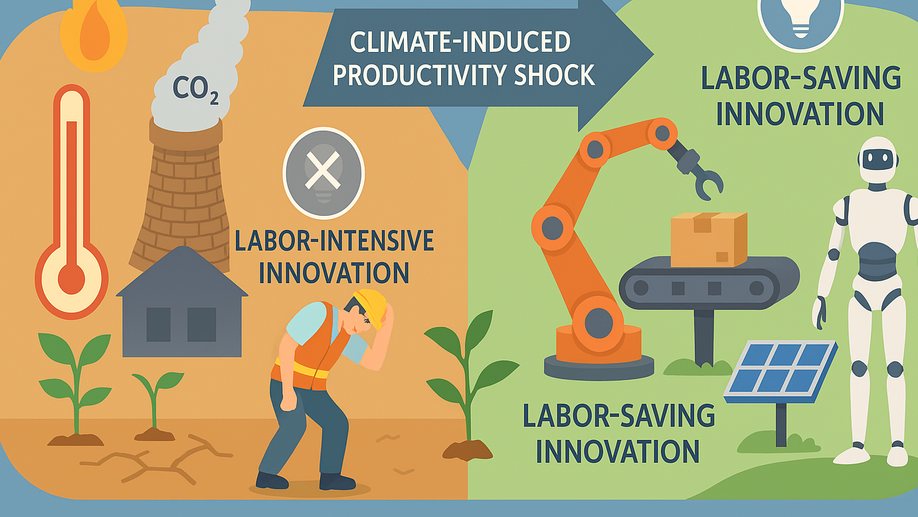
My job market paper, Extreme Heat and Directed Innovation, shows that extreme heat operates as a labor-biased productivity shock and induces capital-deepening, labor-saving innovation that mitigates 26 percent of aggregate productivity losses in European industrial sectors.

I am on the 2025–2026 economics job market.

Interests

  • Environmental Economics
  • Productivity
  • Firm Dynamics
  • Technological Change and Innovation

Education

  • PhD in Economics, 2020-2026 (Expected)

    Cornell University

  • BS in Economics and Statistics, 2016-2020

    University of California, Los Angeles

Working Papers

Climate Change and Market Power

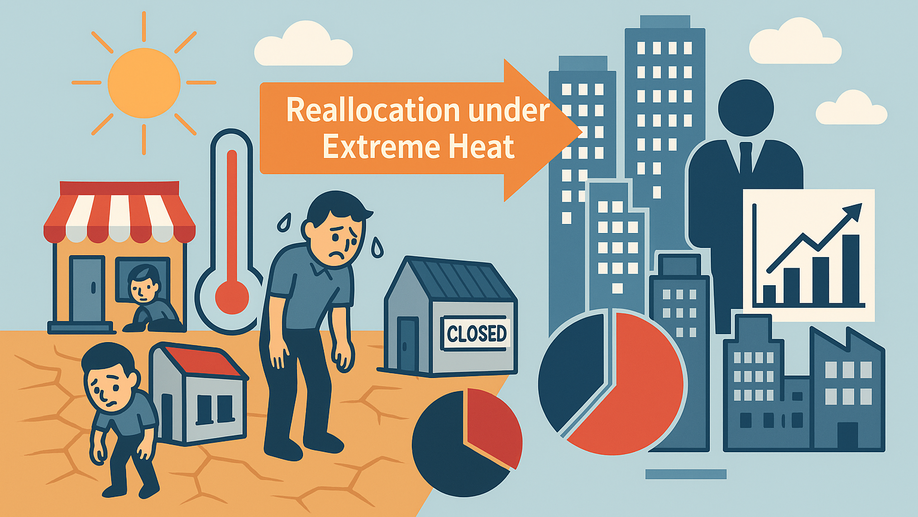
Using manufacturing sector firm-level data from Orbis for 2000–2020, we examine the effects of temperature shocks on industry market power across 12 European countries. Our analysis shows that temperature extremes reduce firm productivity, with significant heterogeneity across firms. Small firms experience larger productivity declines, leading to a reallocation of market share toward larger firms. As a result, temperature shocks increase industry concentration and aggregate markups. To quantify the welfare costs arising from both the productivity impact and the increase in market power, we develop an equilibrium model of heterogeneous firms with a variable elasticity of substitution that endogenizes markups. Based on the estimated marginal effects of temperature shocks on firm productivity and markups, the model suggests that the observed changes in the temperature distribution between 2000 and 2020—relative to a counterfactual scenario in which the temperature distribution remained constant—resulted in heterogeneous welfare effects across EU countries. Spain, which experienced the largest temperature increase over this period, incurred the largest welfare loss, equivalent to 0.44 percent of manufacturing sector GDP. A model that does not endogenize markups would miss over 40 percent of the welfare loss from extreme heat. Our findings underscore the importance of incorporating firm-level heterogeneity and market power into climate impact assessment.

Work in Progress

Misallocation of Climate Innovation - Adaptation vs Mitigation

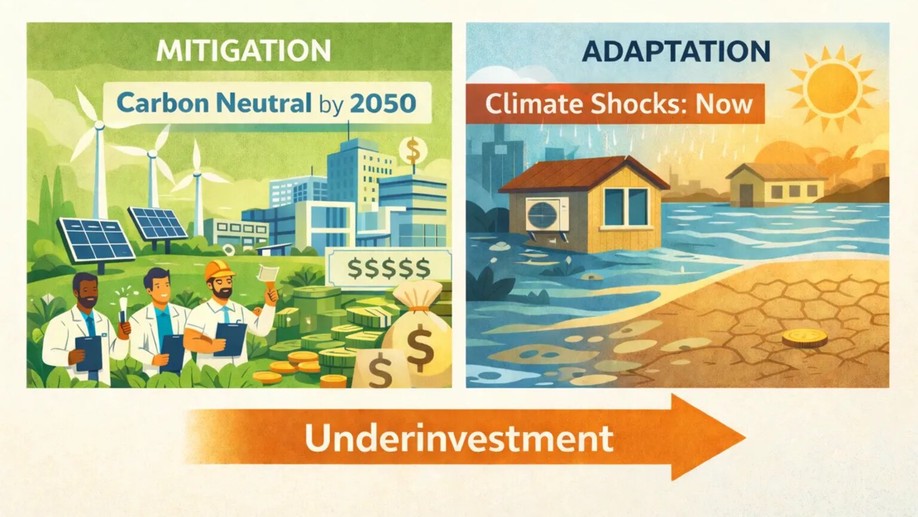
Are we over-investing in climate mitigation technologies and under-investing in adaptation technologies?

Abstract
Climate innovation is overwhelmingly directed toward mitigation technologies, yet adaptation—reducing exposure to damages that are already locked in—may be at least as urgently needed. This paper asks whether the current allocation of inventive effort across mitigation and adaptation is efficient, and if not, what drives the gap. Using four decades of global climate patent data from OECD REGPAT, I document a striking and persistent pattern: adaptation accounts for a small and declining share of climate-related inventive activity, even as climate damages accelerate. I develop a theoretical framework grounded in directed technical change to identify a natural source of inefficiency: adaptation knowledge is structurally harder to appropriate than mitigation knowledge, because adaptation technologies tend to be spatially local and context-specific, making them difficult to protect through standard intellectual property mechanisms. Preliminary empirical evidence supports this mechanism—within-applicant comparisons suggest that firms seek weaker international protection for adaptation patents than for otherwise comparable mitigation patents, with the gap concentrated precisely in spatially local technologies. These patterns point toward a misallocation that carbon pricing alone cannot correct, and motivate a broader research agenda on adaptation-specific innovation policy.

Ernest Liu Family Outstanding Teaching Award (2023-24)

Econ 1110: Introductory Microeconomics (Prof. Nick Sanders)

TA: Fall 2021 (4.5/5), Fall 2022 (4.4/5)

Econ 1120: Introductory Macroeconomics (Prof. George Orlov, Prof. Terence Alexander)

TA: Spring 2023 (4.5/5), Spring 2024 (4.8/5)

Econ 3040: Intermediate Macroeconomics (Prof. Mathieu Taschereau-Dumouchel)

TA: Spring 2022 (4.5/5), Spring 2023 (4.8/5)

Contact